I don’t just build — I invent, protect it, and ship it.
Inventor of three inventions across six patent filings in multiple countries — two as solo inventor, three already issued. Each one became a working system: a provably-optimal recommendation engine, a content-authenticity protocol, and the knowledge-base extraction behind a cognitive chatbot platform.
Why it matters more now. AI coding agents have lowered the effort of building software solutions, so a feature is copied in weeks. What still preserves a competitive advantage and a company’s moat is a patent on the method or the system behind it. I am not a patent attorney: I am an inventor of methods and systems in computer science, engineering and artificial intelligence — spanning blockchain and mathematical optimization — and I work with patent counsel on the filings.
3inventions
6patent filings · multiple countries
2as solo inventor
3already issued
CERTIFICATES · 2026
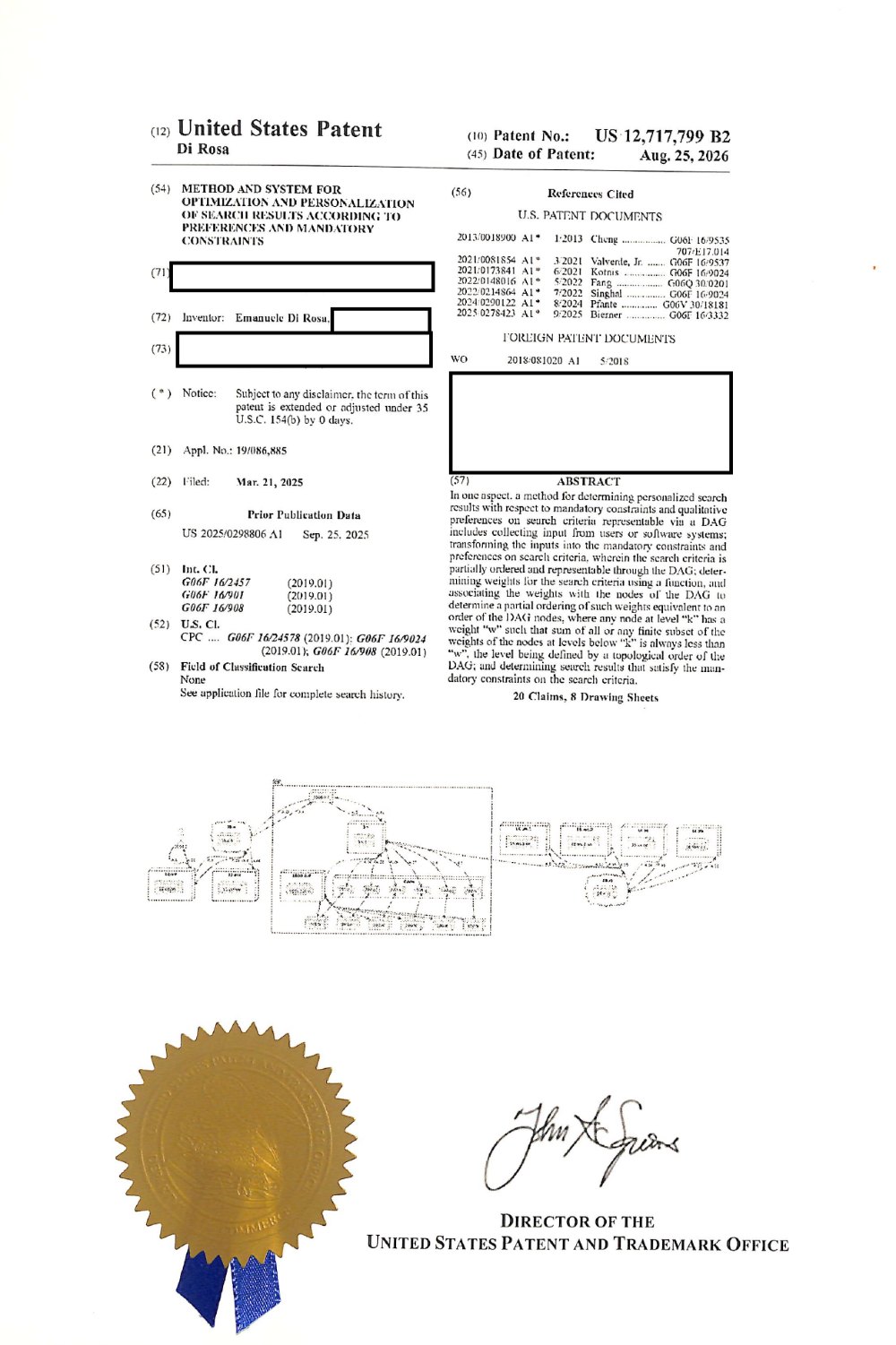
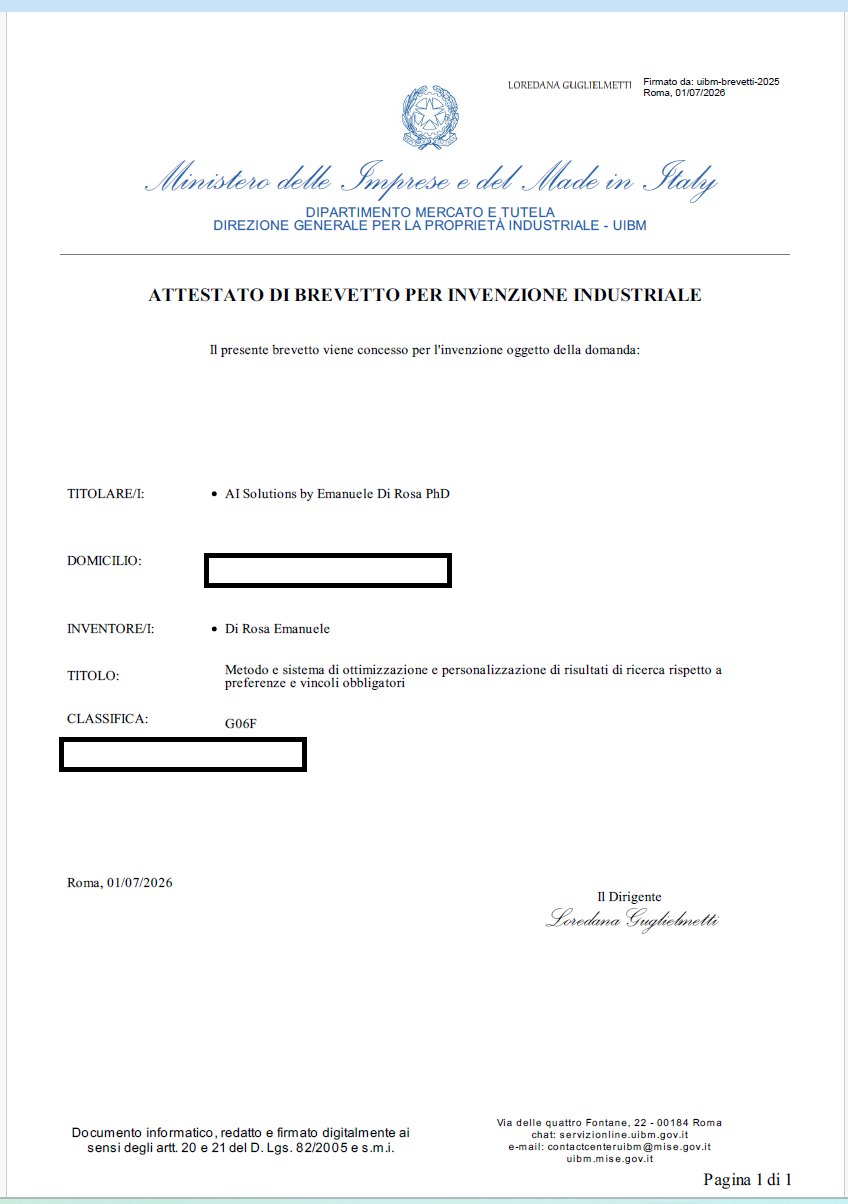
One invention, granted on both sides of the Atlantic.
Method and System for Optimization and Personalization of Search Results according to Preferences and Mandatory Constraints — solo inventor.
UNITED STATESUS Patent 12,717,799 B2Date of patent: Aug. 25, 2026Publications: pre-grant publication US 2025/0298806 A1 · granted as US 12,717,799 B2Scope: 20 claims, 8 drawing sheets · Int. Cl. G06F 16/2457, 16/901, 16/908Google Patents →Video: me presenting it ↓ITALY · EUROPEAN UNIONItalian Patent 102024000006643Granted: Jul. 1, 2026 — Ministero delle Imprese e del Made in Italy, UIBMTitle: Metodo e sistema di ottimizzazione e personalizzazione di risultati di ricerca rispetto a preferenze e vincoli obbligatoriClass: G06F · Inventore: Emanuele Di RosaSame invention as: US 12,717,799 B2, with the same title (Google Patents →); certificate scan on the left of this card.
VIDEO · 3:38The morning the US patent arrivedI recorded this when the ceremonial copy of US 12,717,799 B2 arrived: where the invention comes from — my PhD work on automated reasoning and optimization with preferences — and what it does. From mandatory constraints and preferences, in natural language or in a structured form, it finds the optimal solutions with mathematical guarantees, and keeps them optimal as new candidate solutions arrive over time: an AI agent buying the best product, or planning a trip across flights and hotels.Also on LinkedIn →
THE THREE INVENTIONS
What each one does, and why it matters.
01 · ISSUED — US 12,717,799 B2 · IT 102024000006643 · SOLO INVENTOR
Optimization & personalization of results under preferences and mandatory constraints
Plain language. Computes the mathematically optimal, explainable personalized search or recommendation results while strictly enforcing hard (“mandatory”) constraints and honoring the user’s ranked preferences — “find the perfect apartment, car, job, or laptop” given non-negotiables plus priorities. The engine behind PerfectFinder.ai.
Why it matters. Constraint-aware, explainable, provably-optimal recommendation is a large, under-served space — and the same core improves RAG retrieval and agentic decision-making in search, e-commerce, and agent products.
TECHNICAL DEPTH• Represents mandatory constraints and partially-ordered qualitative preferences as nodes of a directed acyclic graph (DAG).• Assigns node weights with a separation guarantee: no combination of descendant preferences can match or exceed the influence of a single ancestor preference.• Scores and orders candidates that satisfy the mandatory constraints with mathematical guarantees — highest-scored solutions are equally optimal; equal scores are equivalent.• Incremental: discovers additional solutions during the query and re-ranks without restarting — scalable across many databases and third-party sources.• Combines automated reasoning and combinatorial optimization, optionally with LLMs for natural-language preference elicitation and AI agents (shopping co-pilots, multi-party negotiation).
02 · PATENT PENDING — MULTIPLE COUNTRIES · SOLO INVENTOR
Decentralized verification of digital-content authenticity & integrity, with automatic detection of similar content
Plain language. Verifies that a piece of digital content is authentic and has not been tampered with — without relying on a central authority — and automatically detects similar or near-duplicate content, so tampered copies, derivatives, and re-uploads can be linked back to the original. TrueFile.ai.
Why it matters. As generative content floods every channel, portable provenance and tamper-evidence become infrastructure: trust for media, documents, and AI-generated material.
TECHNICAL THEMES• Authority-free (decentralized) cryptographic provenance and integrity verification.• Tamper- and manipulation-evidence for files, media, and documents.• Near-duplicate and similar-content detection to link derivatives to the original.• Complements provenance initiatives such as C2PA, approached without a central middleman.• Patent pending in multiple countries; applications not yet published.• Pending applications are not yet published — patent offices typically publish them 18 months after filing.
Extracting information from unstructured or semi-structured textual sources
Plain language. Builds a chatbot’s knowledge base automatically from FAQs, manuals, and documents — the technology that let EVA, App2Check’s no-code cognitive-chatbot platform, turn a document into a domain chatbot in minutes.
Why it matters. The bottleneck of every support bot is the knowledge base. Extracting it from what already exists made the product deployable at enterprise scale — and it was integrated with Precisely’s EngageOne Converse.
TECHNICAL DEPTH• Generates a representative tree of text nodes from a non-structured or semi-structured source.• Detects “question” nodes with heuristics and/or a predictive model — even without a question mark — by their recurring characteristics.• Attributes features to nodes to assemble a maintainable knowledge base, edited like a CMS.• Inventors: Emanuele Di Rosa, Andrea Bonfiglio, Massimo Narizzano, Pierpaolo Perotto · US 2020/0285810 A1 (published Sept 2020) with an Italian counterpart.
Curious how an idea becomes a patent?
From spotting the patentable part to designing claims that hold, filing in multiple countries, and building the product behind it.