EXPERTISE

What I work on — strategy first, then execution.

Strategy first: a genuinely unique product, the inventions worth patenting, and intellectual property that raises fundability and valuation. Then execution: production systems, patent filings, and research published at top venues with industrial application. Seven areas, one way of working. And a reason it matters now: AI coding agents have made software cheap to build, so the invention behind a product — and the patent that protects it — is what still preserves a competitive advantage and a company’s moat.

STRATEGY FIRST Find what is worth inventing.

Before building anything, the questions that decide value: where can this product be genuinely unique? Which of those ideas solve a technical problem in a new way — and are therefore patentable? What should be patented, what published, what kept secret? Answered well, they turn a roadmap into intellectual property that investors, grant committees and boards can price.

THEN EXECUTION Build it, file it, publish it.

Production systems that beat their baselines and run for real users; patent filings designed with counsel so the claims hold; research written up for top venues — ACL, EMNLP, EAMT — because industrial results deserve peer review. Measured, reproducible, and evidenced rather than claimed.

SEVEN AREAS OF FOCUS · STRATEGY FIRST, THEN EXECUTION

The seven areas, what each involves, and the track record.

01 · STRATEGY

AI & innovation strategy

Where a product can be genuinely unique, which inventions are worth patenting, and how that intellectual property raises fundability and valuation — then the technology roadmap, organization, security and compliance to deliver it. This is the CTO work I do today.

WHAT IT INVOLVES • Innovation and IP strategy: what to patent, what to publish, what to keep secret • The IP story and technical narrative that investors, grant committees and boards fund • Technology and AI strategy; build-vs-buy; TRL-mapped roadmap • Engineering org design; hiring senior and PhD-level talent • Enterprise readiness: security, compliance, due diligence
TRACK RECORD CTO at DATAmundi: AI product strategy and an R&D roadmap that produced ACL 2026 and EAMT 2026 papers and an award-winning product, with research and technology grants, funding and partnership shaping with US and EU universities; security, compliance and finance modernization. Prior CTO & Head of Product at App2Check. Inventor of 3 inventions across 6 patent filings. Verify: CTO appointment →Patents →
02 · STRATEGY → IP

Invention & IP creation

AI coding agents have made software cheap to build; what still protects a competitive advantage — and a company’s moat — is the invention behind it. I turn what is novel in a product into defensible intellectual property and build the feature that embodies it: assessing patentability, designing the invention so the claims hold, and keeping engineering and IP aligned so the patent and the product describe the same thing. I am not a patent attorney: I am an inventor of methods and systems in computer science, engineering and artificial intelligence — spanning blockchain and mathematical optimization — and I work with patent counsel on the filings.

WHAT IT INVOLVES • Patentability assessment — which part is genuinely new • Invention design: claims that survive examination, prior-art positioning • Coordination with counsel through filing and prosecution in multiple countries • The product feature or system that embodies the invention • An IP portfolio plan tied to fundraising and valuation milestones
TRACK RECORD Solo inventor of US Patent 12,717,799 B2 and Italian Patent 102024000006643 — idea → filing → grant → product (PerfectFinder.ai). Co-inventor of the App2Check knowledge-base patent behind EVA, licensed to leading brands and integrated by Precisely. TrueFile.ai patent-pending in multiple countries. Verify: US 12,717,799 B2 →App2Check patent →Certificates →
03 · EXECUTION

R&D & industrial research

Applied research that ships — and gets published. I run the full engine: SOTA review, novel method design, rigorous and reproducible evaluation, publication at top venues (ACL, EMNLP, EAMT) focused on industrial applications, and translation into patents and product — including TRL-mapped roadmaps, research and technology grants, funding and partnership shaping with US and EU universities.

WHAT IT INVOLVES • R&D strategy and a TRL-mapped roadmap: research → product → grants → revenue • Novel methods designed and prototyped, not just surveyed • Statistically rigorous, reproducible evaluation frameworks • Peer-review-grade write-ups for ACL / EMNLP / EAMT / ECAI • Grant-ready technical narratives
TRACK RECORD Set DATAmundi’s R&D roadmap and turned it into ACL 2026, EAMT 2026 and EMNLP 2026 papers, an award-winning product, and grant and funding applications with university partners in the US and the EU. 25 papers; PhD in AI & Software Engineering.
04 · BRAND

Research papers & conference talks

Research written up and presented — at research venues such as ACL, EMNLP and EAMT, and at business conferences — is one of the strongest brand assets a technology company can build. It elevates awareness and reputation with customers, talent and investors, and ultimately company valuation. I write papers from real systems and present them on both kinds of stage.

WHAT IT INVOLVES • Turning a production system or method into a peer-reviewed paper • Rigorous, reproducible evaluation that survives review • Talks and panels at research and business conferences • Press and analyst coverage built on published results • A publication and speaking plan aligned with the product and IP roadmap
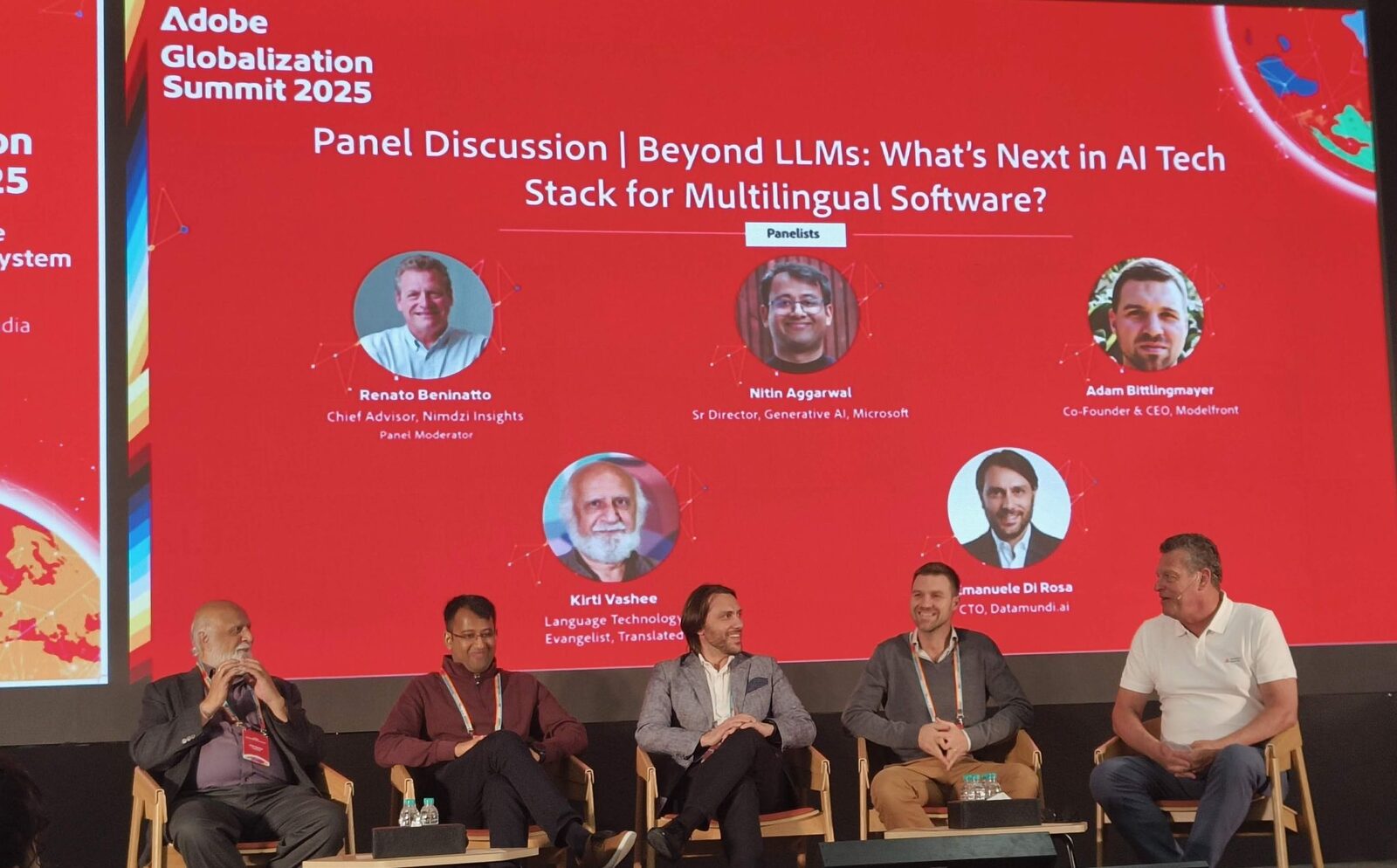
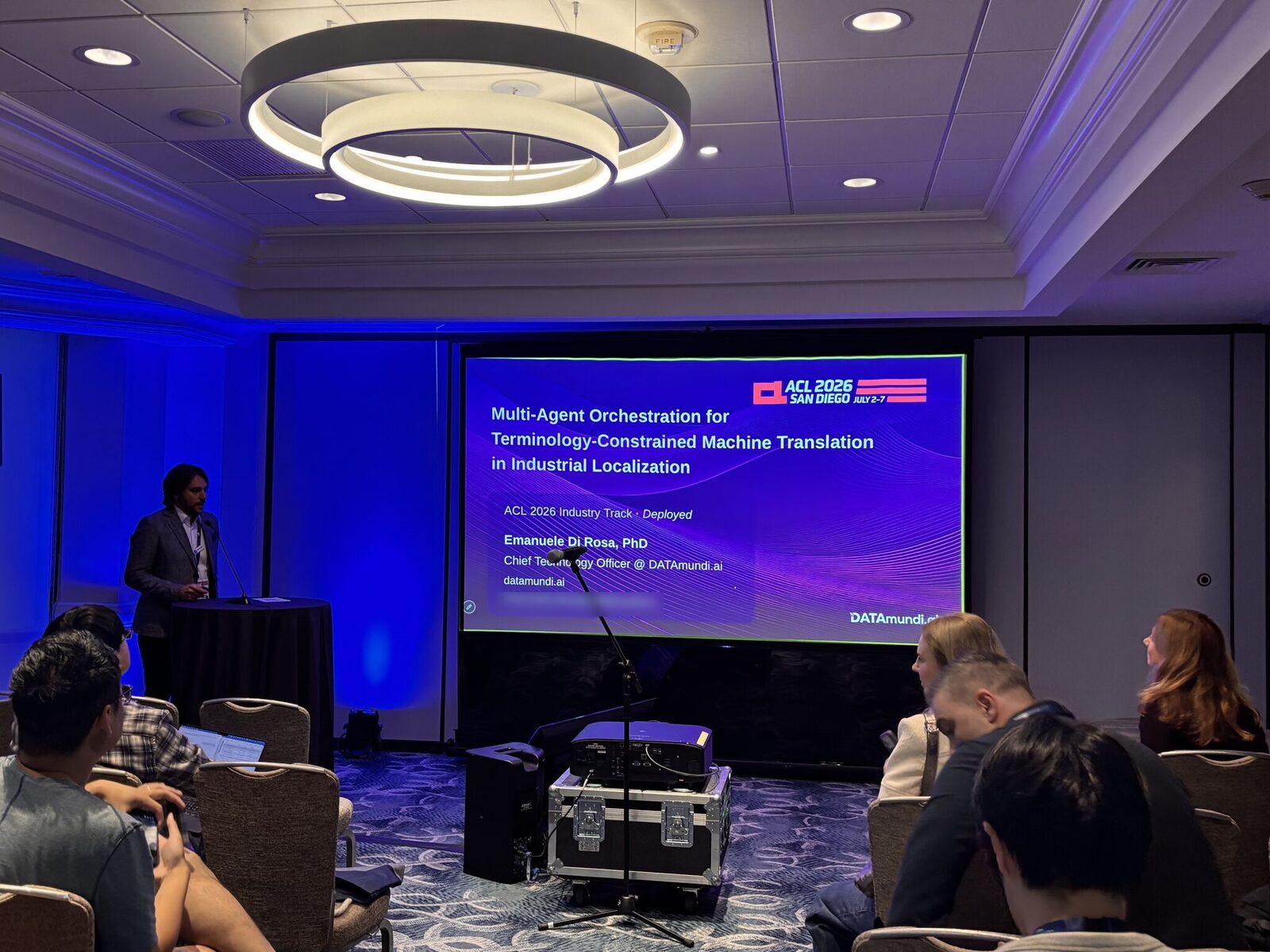
TRACK RECORD 25 peer-reviewed papers. ACL 2026 Industry Track (San Diego), EAMT 2026, PANDORA @ EMNLP 2026; panelist at the Adobe Globalization Summit 2025; Chatbot Summit 2019; Sentiment Analysis Symposium 2017; Slator coverage; for AIDA Agents, a Globee Innovation Award won by DATAmundi and a 2026 AI Excellence Awards finalist place. Verify: ACL 2026 →Slator →Adobe Summit →Chatbot Summit →
Emanuele Di Rosa presenting in the ACL 2026 Industry Track, San Diego
Research stage. ACL 2026, San Diego: multi-agent orchestration for terminology-constrained machine translation, in the Industry Track.
Emanuele Di Rosa on the “Beyond LLMs” panel at the Adobe Globalization Summit 2025 in Noida, India
Business stage. Adobe Globalization Summit 2025, Noida: panelist on “Beyond LLMs: What’s Next in the AI Tech Stack for Multilingual Software?”
05 · EXECUTION

AI agents & agentic systems

Multi-agent LLM systems that work in production: orchestration, specialized agents (generation, rating, post-editing, review), tool use, RAG and context injection, and explainable evaluation — with the rigor to prove they beat the baseline.

WHAT IT INVOLVES • Multi-agent architecture: orchestration patterns, agent roles, quality-control loops • RAG / context-injection design: memory, terminology, style, domain knowledge • Evaluation and guardrails: LLM-as-judge validated against human annotation; red-teaming where safety matters • Production integration and quality/cost tiering • Honest benchmarking vs. SOTA and vs. the incumbent system
TRACK RECORD AIDA Agents: best on 10/11 WMT24++ pairs; 70–98% publication-ready; 99.4% terminology accuracy. Globee Innovation Award won by DATAmundi (Best Multi-Agent System Orchestration Platform); 2026 AI Excellence Awards finalist; ACL 2026 Industry Track; EAMT 2026. Adobe Globalization Summit 2025 panelist on agentic AI. Verify: EAMT →ACL →Globee →AI Excellence →Adobe Summit →
06 · EXECUTION

Workflow automation & process efficiency

Map the process, automate the repeatable, keep humans where they add judgment, and measure the gain. AI agents plus classic integration work — the unglamorous part is where the efficiency comes from.

WHAT IT INVOLVES • Process mapping and an automation roadmap ranked by measurable impact • Agentic and rule-based automation of document, language, and data workflows • Human-in-the-loop design: review flows, quality controls, exception handling • Integrations with the systems already in place (CAT/TMS, CRM, payments, accounting, BI) • Before/after measurement so the gain is real, not claimed
TRACK RECORD 50–70% potential reduction in post-editing effort on the EAMT 2026 industrial benchmark; 99.4% terminology accuracy (ACL 2026). Led the automation of finance, operations and project workflows at DATAmundi.
07 · EXECUTION

SaaS products, browser extensions & desktop tools

From a model or an idea to a real B2B product — or a focused tool that removes friction for a team or a market: multi-tenant architecture, APIs, workflow engines, security and compliance, enterprise integrations, browser extensions and desktop apps, instrumented so you can see the gain.

WHAT IT INVOLVES • Product and platform architecture; AI/ML productization • Scalability, reliability, and performance hardening • Security and compliance programs, including ISO 27001 readiness • Chrome / browser-extension and desktop-app design and delivery • Usage instrumentation, a productivity baseline, packaging and distribution
TRACK RECORD Two B2B SaaS platforms built from scratch at App2Check — licensed to leading brands (Stellantis, Adidas, TIM, UniCredit, Poste Italiane); Precisely worldwide partner. EVA turned FAQs into a domain chatbot (patented knowledge-base extraction); PerfectFinder.ai, a constraint-aware search agent (issued patent). At DATAmundi, leading the modernization of two SaaS platforms: AIDA Hub, for managing data-services projects, including through AI agents, and DATAtalent, for contributors and subject-matter experts. Verify: Precisely / Pitney Bowes →Recommendations →EVA talk →PerfectFinder.ai patent →

Questions I am often asked.

What makes an idea patentable?Usually one part of it — the part that solves a technical problem in a new way. Finding that part, and deciding whether to patent it, publish it, or keep it secret, comes before any drafting.
Do you write the patents yourself?I design the invention and the technical specification; a patent attorney drafts and files. That is how my own filings in multiple countries were done.
Why publish industrial research?Peer review is the strongest evidence that a system works. The ACL, EMNLP and EAMT papers came from systems running in production, not from lab demos.
Do you still build?Yes, where it counts. I design the inventions and the research methods myself; in a company, as CTO, I lead the research team and the implementation, so the patents and the papers come from systems I know from the inside.
Where are you based?Warsaw, Poland (EU), working with people across time zones — and travelling when it matters.
Which domains?AI/ML products, localization and multilingual data, enterprise SaaS, regulated and enterprise AI — and the method transfers broadly.