An AI researcher and engineer who never wanted to choose between the two.
I have been working on natural-language AI since 2003. In 2004, for my thesis in Computer Engineering — Latent Semantic Analysis for man-machine dialogue — I built LSAbot, an early “cognitive” chatbot. Instead of the rigid, rule-based keyword matching common at the time, it used Singular Value Decomposition to map the relationships between words and phrases in a high-dimensional vector space, understood the semantic context of a question, and chose the semantically best answer — a precursor of today’s embeddings, two decades before they became mainstream. It won the Targa Under 30 at the inaugural Pier Giorgio Perotto Innovation Award in 2005, named after the creator of the Olivetti Programma 101, considered the first programmable desktop computer. That has been the through-line ever since: taking ideas at the frontier and making them real. Read the full story →
Formal methods first.
My background is unusually deep on the formal side of AI. I did my PhD at the University of Genoa under Prof. Enrico Giunchiglia, working on automated reasoning, SAT solving, and optimization with qualitative preferences, and I spent time as a visiting researcher at the Cork Constraint Computation Centre in Ireland with Prof. Barry O’Sullivan. That training in formal methods and optimization is rare among today’s applied-AI leaders, and it is the reason my work with large language models looks different: I combine neural models with first-order logic and optimization solvers rather than treating LLMs as a black box.
Then science all the way to revenue.
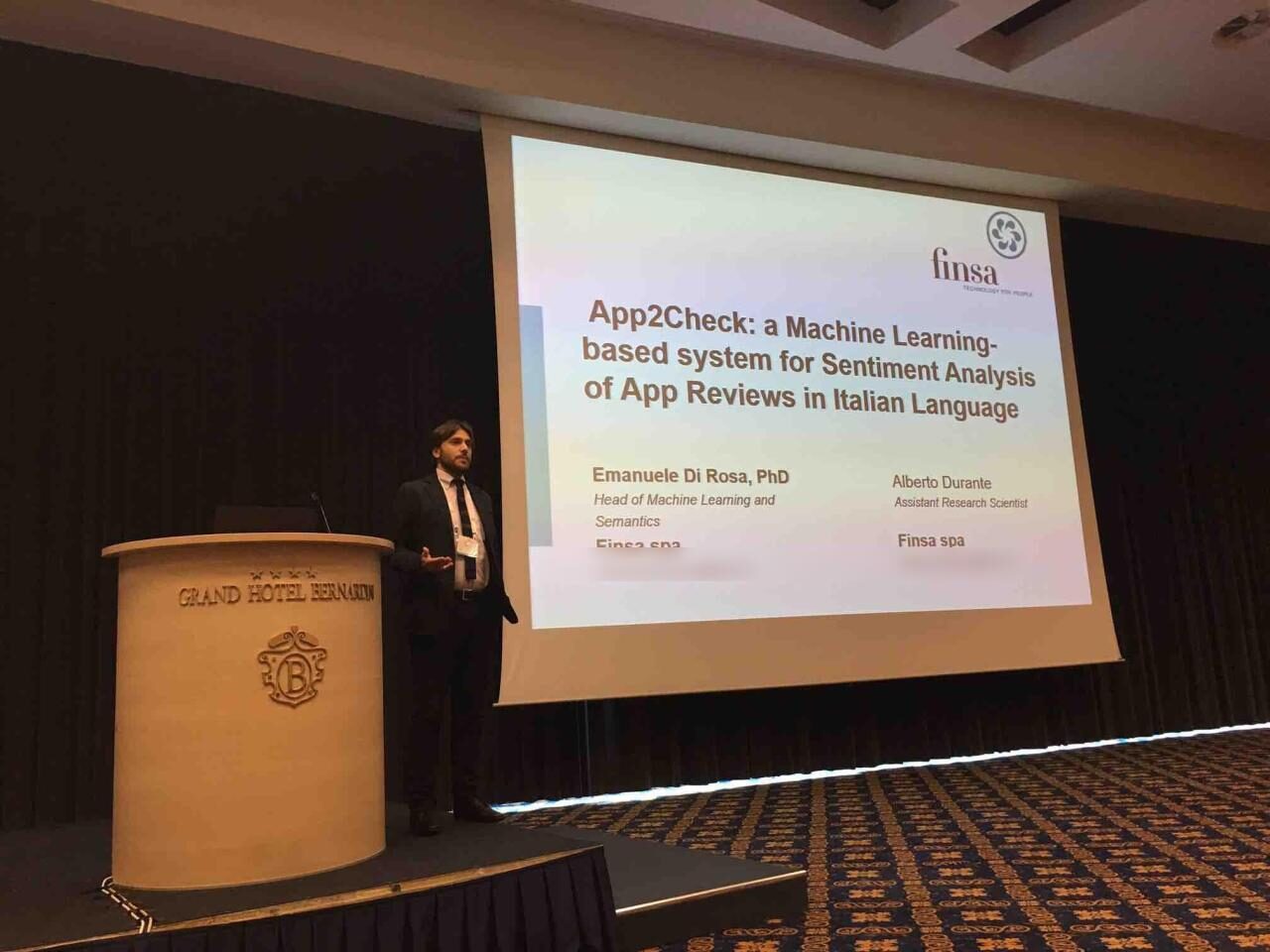
Over 15+ years I moved from software engineering into building and running technology as a CTO. At App2Check — a product venture within the Finsa software group — I acted like a co-founder: I was not one, but the owners gave me the freedom to lead product and R&D as if I were. We built two B2B SaaS platforms from scratch, a Voice-of-the-Customer analytics engine and the EVA cognitive chatbot, licensed them to leading brands, and were selected by Precisely as a worldwide partner. I learned there how to take science to products enterprises pay for — not demos.
Today: CTO, researcher, inventor.
As CTO at DATAmundi.ai (the rebranded Summa Linguae Technologies), I run AI product strategy and a research-to-product roadmap; our clients are primarily big-tech companies, across several of their research and product departments, including frontier labs. I led the research team behind AIDA Agents and its implementation: a production multi-agent LLM platform that beats state-of-the-art machine translation on 10/11 WMT24++ language pairs. It won DATAmundi a Globee Innovation Award in the Best Multi-Agent System Orchestration Platform category, was a 2026 AI Excellence Awards finalist, and is published at ACL 2026 and EAMT 2026. I lead the company’s AI safety auditing research: my formal-logic red-teaming work, published at the PANDORA workshop at EMNLP 2026 with a PhD student from the Georgia Institute of Technology, is now the core of an AI safety-auditing system.
Alongside all of this, I invent. I am the inventor of three inventions across six patent filings — including US Patent 12,717,799 B2 (issued 2026) with Italian Patent 102024000006643, for a method that computes the mathematically optimal search and recommendation results under both preferences and hard constraints, and a patent-pending system for decentralized verification of digital-content authenticity. I am not a patent attorney: I am an inventor of methods and systems in computer science, engineering and artificial intelligence — spanning blockchain and mathematical optimization — and I work with patent counsel on the filings. And as AI coding agents make software ever cheaper to build, the invention is the part that still protects a competitive advantage.
That is the through-line of my work: moving an ambitious AI idea from research to invention to prototype to evaluation to product — and leading the technology while doing it.
Twenty-plus years, one direction.
Awards, talks, and service.
Every award and claim on this site links to a public source where one exists — papers on the ACL Anthology, CEUR-WS and Springer; patents on Google Patents; talks on the organizers’ pages. Testimonials are verifiable as recommendations on LinkedIn →, and there is another recommendation shared on LinkedIn →
Off the keyboard: a musician, and a fan of theater improvisation — human creativity stays at the core of how I think about innovation.