Notes · 29 September 2026 · 7 min read
The moat moved.
AI coding agents made software cheap to build. What stays defensible is the invention, the patent that protects it, and the reputation you earn by publishing what you learned.
The moat is the effort. Nobody has to name it.The effort collapsed. What is left to defend is the invention, and the reputation around it.
Building is no longer the moat
For twenty years the safest answer to “what protects us?” was “the work”. A product took a team, a budget and a few quarters to build, and a competitor who wanted the same thing had to spend the same. The difficulty of building was the moat, and most companies never had to name it.
AI coding agents have cut that difficulty. A feature that took a quarter now takes weeks, and the same is true for everyone else. Anyone who has run an engineering team this year has watched it happen: the agents write, test and refactor faster than the team can review. What they do not do is decide what is worth building, or invent a method nobody has used before.
So execution alone no longer protects a position. It is still necessary, and I still spend most of my days on it. But if what you ship can be rebuilt in a month by a smaller team with a good set of agents, it is worth asking which part of your advantage survives the rebuild.
A patent protects the method, not the code
Here is the part people find counter-intuitive. A patent does not protect your code. Copyright does that, and copyright is weak against a clean rebuild. A patent protects the method or the system described in its claims, however the code is written.
If a competitor’s agents regenerate your product from scratch, the new code is theirs. The claimed method is still yours. That is exactly why patents matter more when building is cheap.
A patent is indifferent to how quickly someone can type.
What can be claimed is narrower than a founder usually hopes and wider than an engineer usually suspects. Not “an AI that recommends products”, but a specific way of representing preferences and mandatory constraints so that the optimum is provable. Not “a chatbot”, but a method for extracting a knowledge base from unstructured text. The claim has to name something new, useful and non-obvious, in enough detail that a skilled engineer could build it from the description. Supplying that is the inventor’s job, and it is the part I do.
I am not a patent attorney: I am an inventor of methods and systems in computer science, engineering and artificial intelligence — spanning blockchain and mathematical optimization — and I work with patent counsel on the filings. Counsel drafts the claims, argues with the examiners and chooses the countries. The inventor supplies what is being claimed, and a system that actually runs on it.
The timing rule matters more than anything else in this note. In Europe, a public disclosure before filing can destroy novelty. The United States allows a one-year grace period, but you should not plan around it. So the order is: name the invention, file, and only then demo, publish and pitch. Filing first also sets the priority date that every later step refers to.
Then the product. A patent on a method nobody built is a certificate, not a moat. My own optimization invention, US Patent 12,717,799 B2 and Italian Patent 102024000006643, is the method behind a working recommendation engine, and that is what makes the claims worth having. The scans below are the real documents; the US page links to the public record.
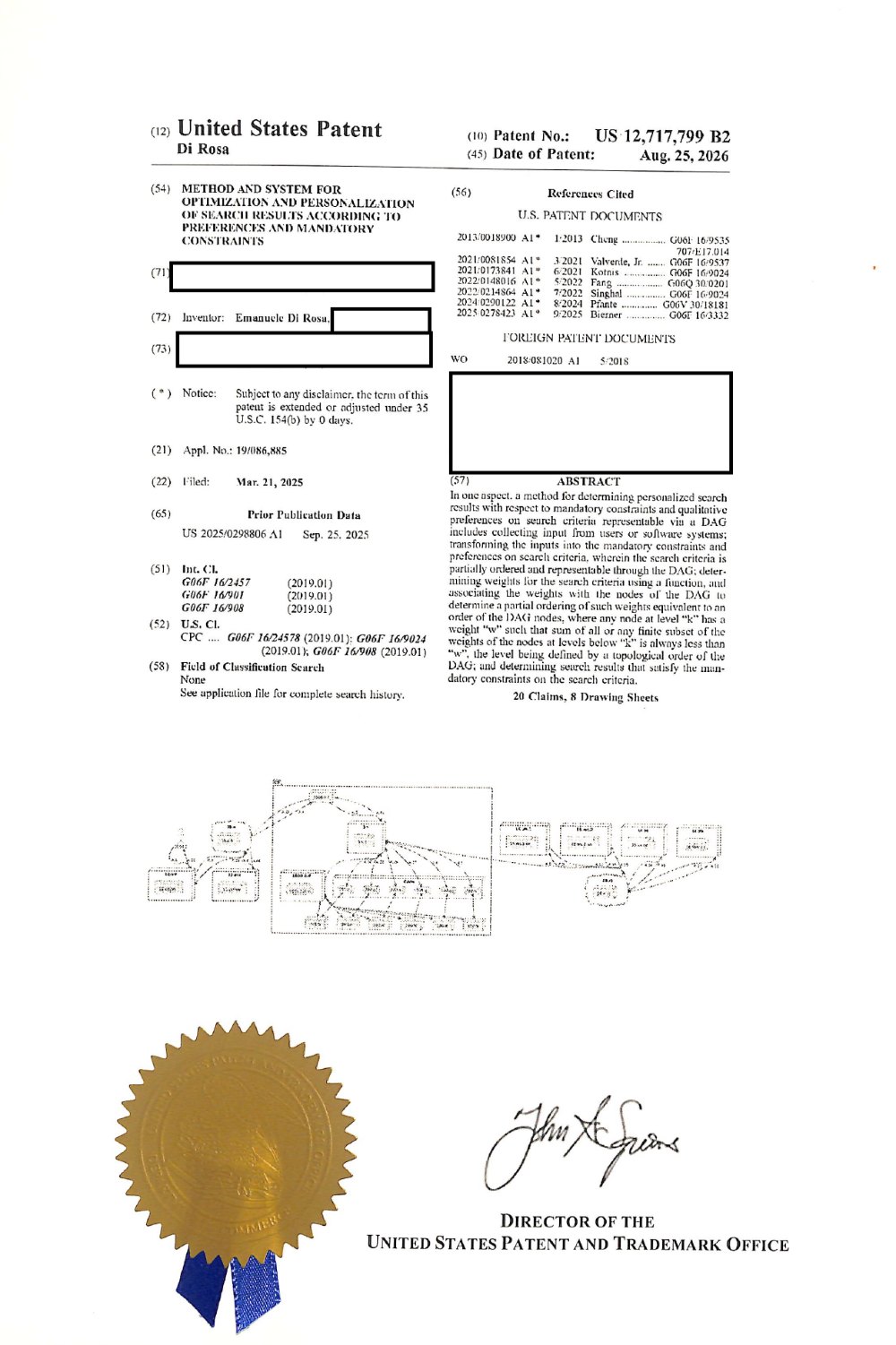
US Patent 12,717,799 B2Front page as issued on 25 August 2026, personal details masked. The B2 kind code means the application was published before grant, so it was public before the claims became enforceable.
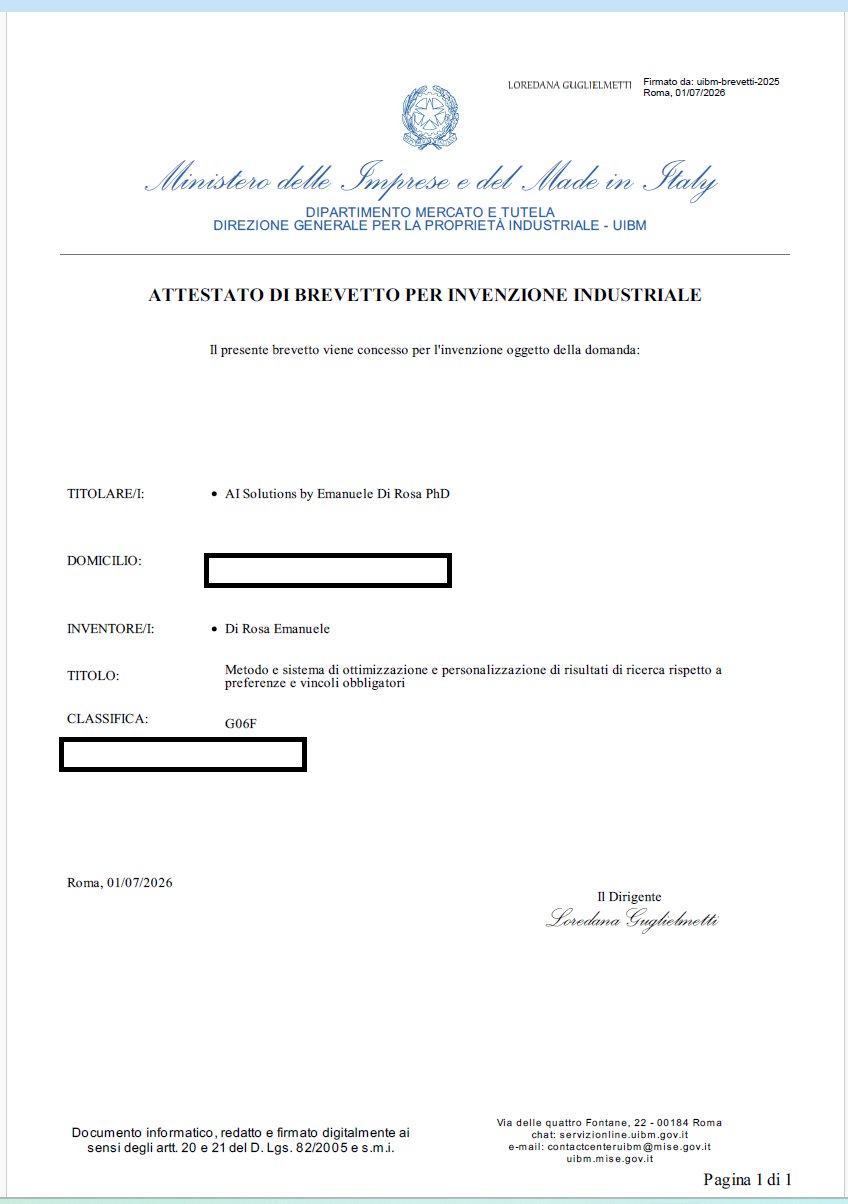
Italian Patent 102024000006643Certificate of the Italian patent, granted on 1 July 2026, personal details masked.
Papers build the reputation
The third part is the one most technical teams skip. Once the priority date is set, write up the industrial application as a research paper and present it, at research conferences and at business ones.
The research venue gives you peer review, an archived citation and credibility with the people who will judge your technology. The business venue turns that credibility into awareness with the people who will buy it or fund it. Together they raise brand awareness, then reputation, and reputation is a line in how a company gets valued.
This is not vanity publishing. The paper forces you to benchmark honestly against the state of the art, which is a better product review than most companies ever run. And a peer-reviewed result is something a competitor cannot generate with an agent: it has to be true.
The loop is short in practice. At DATAmundi I led the research team behind a multi-agent translation platform and its implementation; we published it at EAMT 2026 and extended it at ACL 2026 in the industry track. The benchmarks were covered by Slator, the platform was a finalist at the 2026 AI Excellence Awards, and DATAmundi then won a Globee Innovation Award for it in the Best Multi-Agent System Orchestration Platform category. Every one of those is a link a prospect, a partner or an investor can click, and none of them cost more than work that was going to happen anyway.
Here is the record so far, by publication date, with a category under each entry.
The order of operations
If you run a product company and any of this sounds familiar, the sequence below is the whole method. The order is the point.
- Name the method, not the feature.One page: what is new, why it is not obvious, and what it makes possible. If nothing survives that page, there is nothing to file.
- File before you show.Decide with patent counsel what to file and where, and set the priority date before any demo, deck or paper. In Europe there is no grace period.
- Build on the claimed method.The product should embody the claims, not resemble them. This is also where agents help: the build is cheap now, so spend the saved effort on the part that is new.
- Publish the industrial application.After the filing, write the paper with real benchmarks and real numbers, and submit it where peer review is serious.
- Present twice.Once at the research venue for credibility, once at the business venue for awareness. Then let the press and the awards do their part.
The receipts
Everything in this note links to a primary source, because a claim about defensibility should itself be verifiable.
Patents
- US Patent 12,717,799 B2 · issued 25 August 2026, solo inventor. Italian Patent 102024000006643, granted 1 July 2026.
- Video on LinkedIn · me presenting the US patent.
- US 2025/0298806 A1 · the pre-grant publication of the same application.
- Inventor page on Google Patents · 3 inventions across 6 patent filings, 2 as solo inventor, 3 already issued.
Papers
- EAMT 2026 · AIDA Agents: A Multi-Agent Translation Platform with Context-Aware Quality Control.
- ACL 2026, Industry Track · Multi-Agent Orchestration for Terminology-Constrained Machine Translation in Industrial Localization.
- Google Scholar · 25 peer-reviewed papers, on NLP since 2003. PANDORA workshop at EMNLP 2026, presented in Budapest.
Coverage and awards
- Slator · DATAmundi reports translation benchmark results.
- Globee Innovation Award · won by DATAmundi for AIDA Agents, Best Multi-Agent System Orchestration Platform.
- 2026 AI Excellence Awards · AIDA Agents, finalist.
- Adobe Globalization Summit 2025 · panel; and the CTO appointment in the DATAmundi newsroom.